Preparing the station
See how equipment, barriers and the work area are prepared before a client session.
 Let’s talk
Observe a session. Practise your control. Tattoo with a mentor’s guidance.
Learn the sequence from consultation and stencil placement to hygiene, tattooing and aftercare. Progress from synthetic skin to supervised work when your mentor considers you ready.
Ask about supervised practice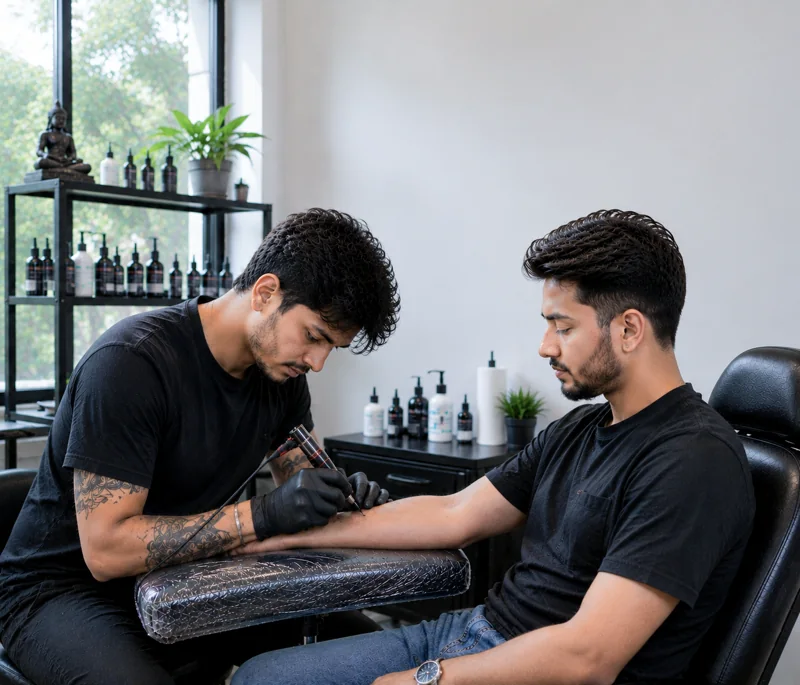


Discuss the design, stencil preparation and placement before the session.
Study body contours, skin stretch and placement with your mentor.
Review equipment preparation, barriers and cross-contamination prevention before practical work.
Learn design confirmation, comfort checks and aftercare explanations.
Ask how needle configuration, technique and voltage relate to the planned work.
See how equipment, barriers and the work area are prepared before a client session.
Follow a session from consultation to aftercare, including stencil placement, working position and pacing.
After observation and synthetic-skin practice, progress to tattooing with a mentor present to guide and correct your technique.
Observe how artists confirm a design, check client comfort and adapt the pace of a session.
Apply barriers and cross-contamination prevention throughout the session, alongside the required equipment preparation and cleaning procedures.
Practise explaining design choices, discussing discomfort and communicating aftercare clearly.
Ask why a particular needle, voltage or technique is chosen while you can see how it affects the work.
Use mentor feedback to identify what needs further practice before taking on more independent work.
You observe mentors and practise on synthetic skin first. Supervised tattooing follows when your mentor considers you ready; ask how readiness is assessed for your batch.
Questions can cover design and stencil preparation, anatomy and placement, hygiene, client communication, needle selection, voltage, depth control and shading.
Yes. A mentor is present during supervised tattoo sessions to guide the work and correct your technique.
Yes. You learn design confirmation, conversations about discomfort, client comfort checks and aftercare as part of the session.
